Creating Custom Furniture Through Collaboration

Role
Research, Design, Branding, Test & Prototyping
Duration
3 months
Tools
Figma
Team
Solo
Overview
The goal of this project was to give consumers better access to sustainable home decor. I wanted to make this process a more positive experience for people, while also gaining insights into patterns and behaviors within the home decor space.
After conducting interviews with individuals who has experience buying home goods, I was inspired to create an e-commerce site that gives shoppers the freedom to create something unique. I managed all aspects of this product including research, testing, brand identity, wireframes, and mock-ups.
Outcome
Discovery
Research Findings
A study done by The Sustainable Furnishings Council’s (SFC) in 2018 provided insight into consumers' feelings behind sustainable decor. These findings revealed that:
-
92% of respondents expressed interest in purchasing environmentally safe home furnishings if style and cost considerations were comparable.
-
Nearly 60% of respondents are willing to pay 5 to 10 percent more for home furnishings certified to be environmentally safe.
Conducting User Interviews
Apart from secondary research, I also conducted five structured interviews with individuals who were chosen based on their experiences purchasing goods for their home. I framed questions that allowed for an open conversation about the participants habits and feelings when shopping for items for their home. Questions I asked included:
-
What does sustainable design mean to you?
-
What frustrates you most about finding decor for your space?
-
What factors do you take into consideration when looking for pieces for your home?
My user interviews revealed several common insights—participants agreed that they were interested in buying sustainable products but were not knowledgeable on where to find these products. The two most important things people look for when purchasing products for their homes are product quality and uniqueness.
Define/Empathize
Organizing Interview Data
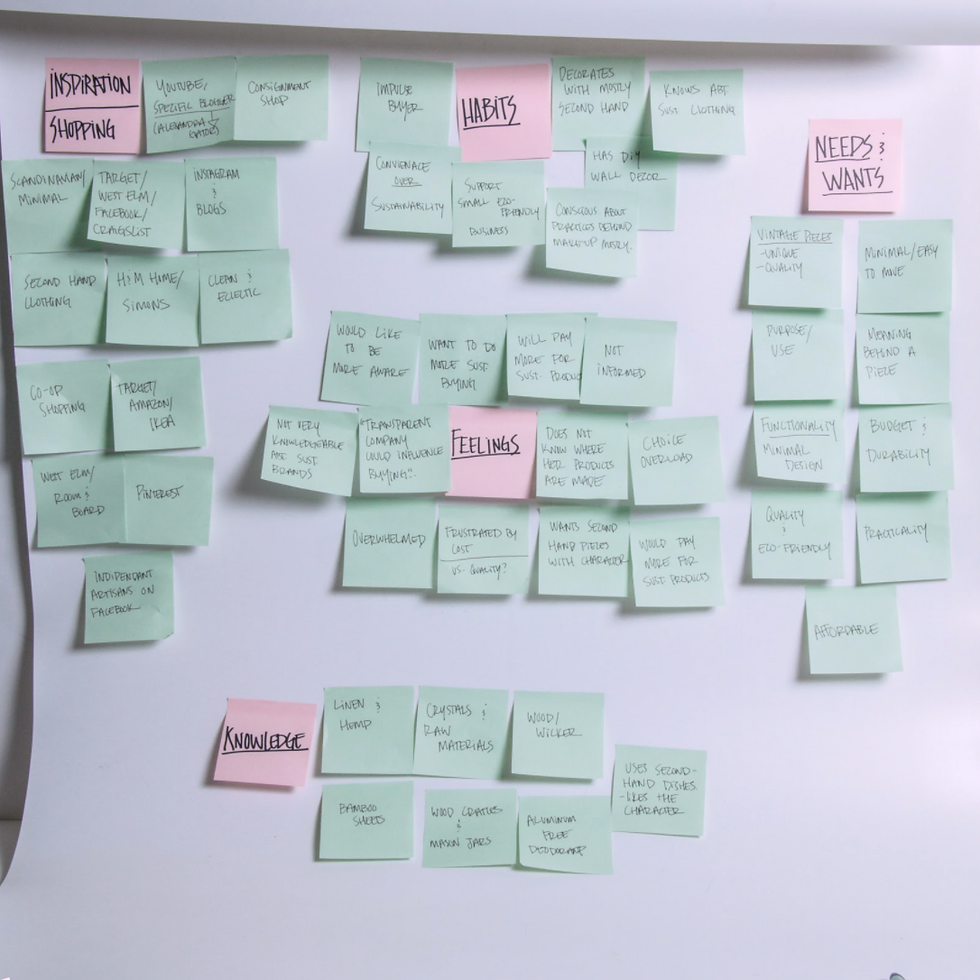
Above is a photograph of how I downloaded and organized the insights I got after conducting my user interviews. I took my notes from each interview and conducted a card sorting exercise and categorized each note into different thougth buckets.
Understanding Users

To digest my findings from the interviews I chose to create an empathy map to better pinpoint specific motives and challenges my users face. By mapping out these key points I was able to craft data driven personas.


From my research, I created two personas to better frame my typical user. My main demographic was Millennials from the ages of 30-40 years old. Focusing on this age range targeted buyers and renters that are actively looking to purchase decor. These consumers no longer want to go to a store and pick out a mass produced item—they want a more unique experience or product. I also included an older population of 50+ who also are at a point in their life where they are swapping houses and in search for new design.
Solution
Solving User Needs
After crafting my personas I started to think of ways to give them access to more sustainable and unique quality furniture that they desire. With this in mine I though of pairing consumers with artisans and craftsmen to create their own custom home decor—an experience that gives the consumer control over the final product.
The experience will allow the shopper will follow a step by step process to create their own unique piece—they will choose what it looks like, what it's made of, and even who it's made by. Allowing the consumer to create their own unique piece makes for a more valuable shopping experience and product. I used a user flow chart to map out the core initiatives of what I wanted to achieve in my product.

Design
Wireframing/Testing
After creating a user flow map I made mock-up sketches and started to visualize what this experience would look like.

These wireframes show a progression of screens that allow you to choose your materials and styles when creating a piece. You are also able to add measurements and photos to better explain what kind of piece you want to make. Your submitted piece is then handed off to a skilled craftsman that will work with you to create your vision. After this process you are presented not only with a handmade product of good quality, but also a design that is unique to you.
Mid-Fidelity Testing
For the main design flow I went staright into some mid-fidelity prototype with pictures. since this process is very visual I wanted the testing feedback to be as effective as possible to give test takers the feeling of actually creating a piece.

Some feedback from the testing of these initial screens helped me to better understand users needs during the creation process.

Style Guide
With my first round of user feedback in mind I started my high fidelity mock-ups of the app. Shopping an e-commerce site should not be an overwhelming experience, and displaying product in a clear and legible manner is a major component of any e-commerce experience. I kept this idea in mind when developing the style guide for my product. I limited my color pallet to a branded green color with shades of black and white.

High Fideilty
With my first round of user feedback in mind I started my high fidelity mock-ups of the app. Shopping an e-commerce site should not be an overwhelming experience, and displaying product in a clear and legible manner is a major component of any e-commerce site. I kept this idea in mind when developing the style guide for my product. I limited my color pallet to a branded green color with shades of black and white.
Screens

Takeaways
Project Learnings
Crafted helped to teach me the UX design process as a whole and exposed me to different tools and processes that are used in order to created a product.
1. I learned to stick to common UX/UI patterns that are used across many platforms. Users have many pre-learned expectations about how product should work and beign able to adhere to these common practices will make it easier on users.
Next Steps
-
I would like to continue this project with further user testing in order to further refine my designs.
-
further nail down a naming convention that resonates best with users and utilize that in a consistent manner across the experience
-
further nail down a naming convention that resonates best with users and utilize that in a consistent manner across the experience
Lets connect!

© 2023 by Name of Site. Created on Editor X.